
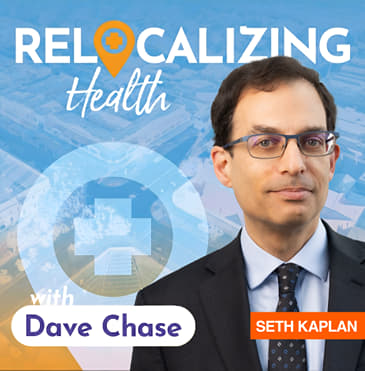
Welcome to Relocalizing Health. In this episode, Dave Chase explores the powerful connection between neighborhood cohesion and health with guest Seth Kaplan, author of Fragile Neighborhoods. Over recent decades, American communities have suffered from declining local relationships, and with no meaningful incentive to make neighborhoods better, both public and private institutions have unintentionally worked in silos, often leaving health outcomes and the social fabric itself worse off.
But there's a movement underway. Across the globe, from Singapore to the Netherlands, new models of healthcare have emerged, focused on empowering residents and rebuilding care around neighborhoods rather than institutions. Drawing on case studies and lessons from around the world, Seth Kaplan and Dave Chase discuss how shifting our mindset, restructuring incentives, and revitalizing neighborhood governance could radically improve health, reduce costs, and revive a sense of belonging.
Join us as we explore what happens when the neighborhood, not just the individual, becomes the patient, and how each of us can spark change, starting right where we live.
Timestamps:
00:00 Community-driven healthcare models
04:46 Exploring American social cohesion
07:55 Flaws in the American healthcare system
12:50 Yishun Health community engagement strategy
16:55 Creating community healthcare nodes
20:08 Fostering Health in Communities
22:55 Community and Charity Involvement
26:39 Growing small health plans into communities
31:50 Sovereignty and healthcare systems
33:07 Rural electrification and community action
36:31 Neighborhood-centered governance ideas
40:10 Neighborhood improvement incentives
45:01 Public sector's role in healthcare
47:02 Importance of social relationships
53:01 Rethinking and nurturing new ideas
54:39 Community-led healthcare initiatives
Neighborhoods as Patients: Insights from the Relocalizing Health Podcast
The latest episode of Relocalizing Health brings a unique perspective on healthcare transformation by focusing on neighborhoods themselves as the true "patients." Hosted by Dave Chase, the episode features guest Seth Kaplan, author of "Fragile Neighborhoods," as they explore how place-based strategies can revitalize both community ties and overall health outcomes.
The Decline of Local Relationships
Dave Chase and Seth Kaplan open the discussion by noting that, despite advancements in many areas of American society, local relationships have deteriorated. Seth Kaplan shares that, for decades, there's been no real incentive for anyone to improve their neighborhoods. This decline has ripple effects throughout many sectors, but it is particularly impactful for health. When local social capital is weak, people lack supportive relationships that can directly influence their well-being.
Mindset Shifts and Siloed Systems
A major theme of the episode is the need for a critical mindset shift. Seth Kaplan points out that systems in the US, including healthcare and government, often govern by silo rather than by neighborhood. This siloed approach leads to fragmented funding and governance, as Dave Chase explains. When agencies are not organized around neighborhoods, money is allocated without accountability for place-based results. The result is a system that fails to foster strong, connected communities.
Global Models: Learning from Singapore and Beyond
One of the most compelling parts of the conversation is Seth Kaplan's exploration of global models. In Singapore, healthcare was reorganized into geographically focused entities with financial incentives to invest in the health of specific neighborhoods. Programs started as organized activities in community nodes, where healthcare professionals acted more as facilitators than as traditional providers. Over time, these efforts led to self-sustaining activities and relationships initiated by residents themselves.
Dave Chase highlights similar models, such as the community health worker initiatives in Baltimore and the Nuka System of Care in Alaska. The success of these models lies in moving healthcare engagement from the clinic into the community, emphasizing relationships and tailoring support to the actual needs and contexts of neighborhoods.
From Programmed Activities to Resident Ownership
A noteworthy insight from Seth Kaplan is how thriving neighborhoods eventually reach a tipping point where healthcare providers can step back, allowing residents to take over community initiatives. Initially, providers play an active supporting role, but as social networks strengthen, a virtuous cycle is established. This cycle fosters trust, collaboration, and local leadership, all of which improve health outcomes organically.
Examples like the transformation of a shoe cabinet into a community library in Singapore illustrate how small, resident-driven initiatives can transform community spaces, making health and connection part of daily life.
The Power of Microgrants and Institutions
For those starting from scratch, Seth Kaplan suggests leveraging microgrants and local institutions. Even grants as small as $500 or $1,000 can catalyze block parties, potlucks, or other events that bring people together. Local institutions, from libraries to schools or faith organizations, provide space, credibility, and resources to help these efforts scale.
Overcoming Structural Barriers
Both speakers stress the challenge of aligning incentives within the current US healthcare and governmental systems. Often, there is no financial motivation for large institutions to invest in neighborhood vitality. A potential solution, they propose, is the creation of new entities or governance models that direct resources to neighborhood-based outcomes, capturing the value that comes from improved health, reduced social services costs, and more vibrant local economies.
A Call to Action: Everyone Can Start
The episode closes with a powerful message of hope and agency. Communities need not wait for top-down directives. Whether you are a school board member, a mayor, or a local employer, you can begin by fostering connections on your block or through your organization. As Seth Kaplan affirms, strong neighborhoods lead to joy, resilience, and better health for everyone.
In summary: The Relocalizing Health podcast episode offers a roadmap for shifting focus from treating individuals in isolation to nurturing thriving neighborhoods. By learning from international examples and applying place-based strategies, communities can reclaim their healthcare destiny and create long-lasting improvements in well-being.
For more on this transformative approach, listen to the full episode featuring Dave Chase and Seth Kaplan.
Learn More:
RosettaFest 2027 - https://rosettafest.org/
Health Rosetta - http://healthrosetta.org/
Nautilus - https://www.nautilushealth.org/
Kynexions - https://kynexions.com/
Dave Chase - https://www.linkedin.com/in/chasedave/
Podcast Website - https://relocalizinghealth.com/