
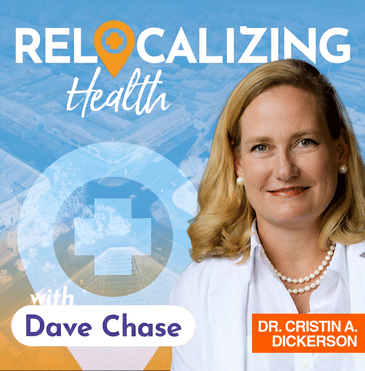
Welcome to another episode of Relocalizing Health. Today, we explore how something as simple as rethinking medical imaging can spark a transformation in employer-sponsored healthcare, creating real wins for employees, employers, and communities alike. Host Dave Chase is joined by Dr. Cristin A. Dickerson, a radiologist and founder of Green Imaging, whose innovative approach has brought bundled transparent pricing to imaging services in thousands of communities across America.
Together, they discuss why imaging is often the first and most powerful step for organizations seeking to take control of their healthcare spending, breaking down the barriers that have long frustrated patients, from lengthy authorizations to surprise bills. You’ll hear real-world stories of school districts, cities, and counties that have saved millions, improved employee access to care, and even turned health plan savings into raises for their staff.
Dr. Cristin A. Dickerson shares how building trust, local partnerships, and simple processes can empower even the most change-averse organizations to take meaningful action. If you’ve ever wondered how health plan innovation really happens or what it takes to move from frustration to affordable, accessible care, this episode is for you.
Timestamps:
00:00 Decision-making in public health plans
05:26 Imaging as a crucial first step
06:56 Partnering with Imaging Centers
13:11 Barriers to accessing healthcare
15:49 Getting Brevard County's Approval
17:11 Improving radiology authorization process
22:45 Changing Health Plans Off-Cycle
25:31 Targeting healthcare decision-making
29:39 Hospital billing and negotiation challenges
31:57 Credit unions and hospital practices
36:22 Discussing the Health Reset Dividend
38:47 Affordable healthcare access benefits
41:18 Closing and sign-off
Inside the Future of Employer Health Plans: Insights from Dr. Cristin A. Dickerson and Dave Chase
Health care costs are on everyone’s mind, but when it comes to employer health plans, especially for public entities, rising costs and complicated processes have become the norm. In the recent episode of the Relocalizing Health podcast, Dr. Cristin A. Dickerson and Dave Chase shared game-changing ideas about how innovative approaches to imaging and benefits design are saving millions, improving access, and restoring choice to communities across the country.
The High Cost of Navigating Healthcare
At the start of the episode, Dr. Cristin A. Dickerson highlighted a shocking reality: the average American spends eight hours each month navigating care for themselves or a loved one. This time is spent dealing with confusing authorizations, chasing down appointments, and dealing with insurance paperwork. Dr. Cristin A. Dickerson explains how this complex maze of healthcare administration not only frustrates patients, but also holds back public entities and employers from offering more competitive wages.
Rethinking Imaging as the First Step to Change
When discussing entry points for making employer health plans better, both Dr. Cristin A. Dickerson and Dave Chase agreed that imaging services like MRIs and CT scans are the low-hanging fruit. As Dave Chase recounted, superintendents and civic leaders would rather pay 100 percent of a moderately priced scan than a partial amount of an outrageously expensive one. This core insight led Dr. Cristin A. Dickerson to found Green Imaging, a network providing bundled, transparent pricing for imaging and related services.
Localized Care Builds Trust and Access
A powerful theme from the podcast is the value of localizing healthcare resources. Dr. Cristin A. Dickerson shared that Green Imaging intentionally partners with existing community imaging centers and physician practices instead of opening new locations. This approach builds trust and familiarity for patients and keeps care aligned with community providers. The results speak for themselves: Dr. Cristin A. Dickerson has seen Green Imaging’s strategies succeed in over 800 public entities nationwide, offering savings and better patient experiences.
Making Change Manageable for Employers
One of the episode’s most useful insights is that change does not have to be overwhelming. Dave Chase pointed out that for mayors, school boards, and HR teams, adopting new healthcare solutions can feel daunting. Dr. Cristin A. Dickerson emphasized that starting with a single benefit, such as improved imaging, is manageable and builds confidence. Over time, these small steps unlock the potential for larger changes, including bundled surgeries, advanced primary care, or even new pharmacy solutions.
Overcoming Barriers to Adoption
For many school districts and municipalities, access to care is just as pressing as cost. The City of Plano, Texas, is a prime example, where leaders discovered that their biggest challenge was not only reducing costs but also improving access. By adopting bundled imaging solutions, more people received the care they needed when they needed it. Dr. Cristin A. Dickerson explained that educating decision-makers with clear data showcasing savings and improved healthcare outcomes is key to driving adoption.
Word-of-Mouth Transformation
A unique aspect of change within the public sector is the power of word-of-mouth. As Dr. Cristin A. Dickerson illustrated through the example of the School District of Osceola County, satisfied users become ambassadors, helping educate their peers and drive further adoption. Over several years, these relationships and trust have resulted in enormous hard savings, estimated at 18 million dollars for that district alone.
The Bigger Purpose: Creating New Choices
The podcast episode ended with a call to action. Every employer and civic leader, regardless of their role in benefits, has a responsibility to explore innovative models that cut out wasteful middlemen, lower costs, and put money back into people’s pockets, whether through better wages or improved benefits. As Dave Chase concluded, the health reset dividend is not just about saving money; it’s about creating new choices, improving care, and restoring community trust in the health system.
For more in-depth perspectives, listen to the full episode of Relocalizing Health and discover how you can take the first step to transforming your organization’s health plan.
Learn More:
RosettaFest 2027 - https://rosettafest.org/
Health Rosetta - http://healthrosetta.org/
Nautilus - https://www.nautilushealth.org/
Kynexions - https://kynexions.com/
Dave Chase - https://www.linkedin.com/in/chasedave/
Podcast Website - https://relocalizinghealth.com/
[00:00:00] And now the average American is spending eight hours a month navigating care for themselves or a loved one. A superintendent at a school district put it to me really simply, he said, you know, I'd much rather pay 100% of a $500 MRI than 80% of a $5,000 MRI. They can get imaging at zero out of pocket for people when they need it. The employer says this is money that can go back into your pocket. This is wage stagnation for the last 30 years. This is what's driving it.
[00:00:28] If you will use these tools that we've given you, we can afford to pay you more.
[00:00:50] You know, when a county commissioner in Missouri or a school board member in Florida decides to change how their health plan works, they're not just moving numbers on a spreadsheet. They're putting their name on a decision that thousands of neighbors, employees, voters are going to hold them accountable to for years. And, you know, that's a heavy thing to ask someone who answers to the public. I don't know if I mentioned this on the podcast before.
[00:01:16] I've actually been a city councilman, so I understand that from that vantage point. So, you know, the smart ones don't just start by ripping off the Band-Aid and going crazy. They start a step at a time. And as we're going to hear today, one of the really smart places to, you know, make those first steps is might be with a single MRI. You know, a scan doesn't ask a school board to overhaul everything.
[00:01:41] It just asks them to trust, you know, a machine at a particular price on a Tuesday afternoon. And it's a great way where trust can be built brick by brick. And once it's earned, it has a way of really compounding. And my guest today is a radiologist. And she's watched that happen more than 800 times in city halls and school district offices across the country.
[00:02:07] And during this conversation, we're going to find out what that first rung looks like and what happens once a town decides to take these steps. And my guest is Dr. Kristen Dickerson. She is a trained radiologist and including cancer imaging work at MD Anderson.
[00:02:27] And for 13 years, she practiced at a clinic in Houston where she also oversaw the clinic's own health plan that was self-funded. And that's a detail I want to have you hold on to for a minute, you know, because really before she ever tried to fix anybody else's plan, she was the one signing off on her own group's health plan.
[00:02:50] You know, watching the invoices, watching the costs, feeling the price of a scan or a surgery land on her own organization's budget. In 2011, she founded Green Imaging to bring transparent bundled pricing to imaging such as MRIs and CTs and ultrasound and mammography.
[00:03:13] And more recently has expanded even beyond that to things like sleep studies, which I heard recently on an interview she had. And today her network covers more than 2,700 sites.
[00:03:26] Maybe I'll get an updated figure if it's changed in all the states and works directly with well over 800 different public entities, such as municipalities and school districts, alongside more than 1,000 self-funded employers around the country. Kristen, welcome to Relocalizing Health. Thanks so much, Dave. Excited to be here. Yeah, looking forward to the chat.
[00:03:49] So as I mentioned, you ran a self-funded health plan for, you know, over a dozen years before you ever really got into the side of things we're at now. From that experience and sitting on the purchaser side of the table, what did that teach you that, you know, maybe would have been pretty hard to learn any other way? As blessed with, that was really my MBA.
[00:04:13] I was managing partner of a 50-doctor multi-specialty group in Texas Medical Center, and I had a CEO and CFO. And so we had a brilliant CEO who came in and had really changed the health plan for her West Texas practice. And she came in and she said, okay, we're going to use this Blue Cross Blue Shield plan. And I'm hearing this more and more, you know, in our current ecosystem. This is going to be our catastrophic coverage.
[00:04:39] We're going to provide the care that we're already offered to patients at zero out of pocket to our members. And then we started adding doctors around us, doctors in the same office building, direct contracting with them, not through the plan. And it was so much easier and simpler and cheaper. Our members got great care and they loved it. And so that was really a tremendous opportunity for me to come to understand how self-funding works.
[00:05:04] And to work actively in the system, you know, adding doctors that our employees thought would, you know, be a value to the plan. So that was, you know, a great opportunity. And really, I started Green Imaging on a business-to-consumer model for proof of concept. But very quickly, you know, I knew that it could move into that self-funded space. Yeah, that makes sense.
[00:05:27] And, you know, I saw at a Benefits Pro panel, you were asked, you know, what's the very first move an advisor makes with a new client? And, you know, you'd expected the answer to be, you know, pursuing something like advanced primary care. But that wasn't the case. It was actually imaging. And obviously, you're in the thick of that. Why do you think imaging is that first step and why that, you know, can be a place that people are willing to start?
[00:05:57] Because, you know, even if change can really improve things, it can be scary for folks. And I remember a superintendent at a school district put it to me really simply, say, you know, I'd much rather pay 100% of a $500 MRI than 80% of a $5,000 MRI. So curious what you're seeing and why you think it starts there. Yeah. You know, a couple of things. But number one, nobody has a favorite radiologist except my husband.
[00:06:26] It's just, it's not like your pediatrician or your OB-GYN. I will not call it a commodity because there's so many things we do that are different than just having a direct contract with an imaging center. But it is more, it is more, it's something you can manage more like a commodity if you have the right solution in place. And so I think that's super important. I think the other thing, and this gets to, you know, some of your concepts about localizing care.
[00:06:53] You know, we have been very careful not to, so what we do is we work with existing imaging centers. My problem, you know, when I was just going to open an imaging center and provide lower cost care was I ran into issues with that. The imaging centers I was reading for were operating out of network. People still had good out of network benefits then. And, you know, because they didn't get paid well in network. And then the hospital systems were acquiring imaging centers and they were costing three times more overnight.
[00:07:22] So I just wasn't going to be able to build centers. But I got the idea of these centers that were operating out of network were at 50% capacity. Why not buy their excess capacity? We would read the study and bill at a bundled rate, a fair bundled rate. And, you know, that worked out really well. So we're very careful to localize care. We could go in now to so many communities and just open an imaging center and it would be full overnight. But that's not how we got here.
[00:07:47] We got here working with existing centers, working with medical practices, DPCs that are putting in ultrasound or x-ray, really operating within the community and the known entities, you know, the doctor practices that people, you know, have known in that community for a long time. And we're using those and putting together a network that serves the self-funded community there.
[00:08:10] Let's make it concrete for, you know, you're talking to a mayor or county council person, you know, somebody needs an MRI on their knee. Walk me through kind of the old way that can easily turn into a giant bill versus the way it works now once you have your approach in place. Okay.
[00:08:35] Now the average American is spending eight hours a month navigating care for themselves or a loved one. You get an order from your doctor and maybe they send you, you know, down the, tell you to go down the hall and get scheduled. And there's an auth process. And that's what I'm hearing more and more from my municipalities and school districts is their employees are so frustrated. They can't get their work done. The teachers, you know, hanging on the phone trying to get the auth done.
[00:09:00] And auths are with some of the, you know, major players are carrying out two months now. And so you've got to get that authorization in place before you get that. Ultimately, you go in, they're going to tell you some amount they're going to collect and they're not always right. You know, is it going to be 20%? Is it that copay apply? Is this really advanced imaging? You know, may or may not get that right. And then there's another factor there. They're going to collect that up front. Then you're going to get another bill, maybe, maybe two, one from the facility and one from the radiology group.
[00:09:30] It's way too complex. And then you're going to get an appeal now that No Surprises Act has backfired. And these radiology groups are going out of network with the major carriers. And then they're appealing every single claim and getting them settled for crazy amount. And so it's a mess out there right now. And it doesn't have to be. If somebody, you know, has an order from their doctor, if it's a DPC, if it's somebody who has advanced primary care, we're working with them. They already know how to get on our portal and they can follow the lifecycle of the order all the way through there.
[00:10:00] They can see what the price is going to be. But, you know, it's as simple as taking a snapshot of your order and benefits card. You can securely text it to our main number. We'll handle all the scheduling. We'll handle the rescheduling. You'll get a little voucher that you take into the imaging center. That's to break the habit of presenting your benefits card when you get there. You have the exam. Nothing's collected. And you're all done. The report goes to the doctor just like it would from any other imaging center. Yeah.
[00:10:28] So it's almost like, you know, TSA pre or clear, like kind of fast pass as you go in. I like that. Like a fast pass. Yeah. So, you know, you've worked with several hundred, you know, public entities I mentioned. And, you know, when it say a school leadership team that's considering something like that, what do you find is the biggest obstacle?
[00:10:53] You know, is it that the math is confusing or is it something more like politics or fear of change or personal relationships? What do you tend to see are the big obstacles and what's the most effective way to contend with those? Because they could be, you know, legitimate concerns people have. There were more obstacles, I would say, several years ago. I'm seeing more and more that people are looking for solutions.
[00:11:22] If we can get in front of the HR team, if we can get in front of the advisors, there's a good chance we're going to be able to convince them. We're going to show them data that convinces them that they can do this. They can give imaging at zero out of pocket for people when they need it. These people are avoiding care right now. They can get this care when they need it, not wait till it's more advanced disease. They can do that and save money. You know, it's kind of like Lester Morales says, duh, why wouldn't you do this?
[00:11:51] And so, you know, it really, if we get in front of them and we get the data. And I would say, Dave, that it's getting the data that's often the challenge. We have the Health Rosetta letter, that fiduciary duty letter that we pass off to our advisors and HR people who are struggling with trouble. There, we also have thousands of case studies.
[00:12:13] We have so many employers data that we can usually find a similar size district, same kind of geographic density, same, you know, network. We can come pretty close and we've been very good at predicting those savings. Yeah, let's talk about one of those. You know, tell me about the city of Plano, Texas. And I heard you say that access mattered as much as cost there.
[00:12:40] What actually happened, you know, for the employees there? And just give us a little rundown on that scenario. Sure. Andrea Cockrell runs that health plan and she's an ex-CFO. And so she really gets it. And it's fantastic. We've been on panels together. And we were on a panel at Houston Business Coalition on Health. And what she said was, we brought green imaging in to solve the problem we knew we had, which was a cost problem. And she said, what we found we did was we solved an access problem we didn't know we had.
[00:13:11] And that access problem is two-pronged, I think. Number one is 60% of Texans are delaying care or not getting care because they can't afford it. We know that from, you know, we have employers that have, you know, a small percentage of their members on an HSA plan. And if they insist on, you know, there are a lot of strategies for getting around that first dollar coverage.
[00:13:31] But if they insist on, you know, the first dollar coverage limitation there, you know, imposing the statutory minimum deductible or the full deductible, even at our lower pricing, 75% of those members go without care because they can't afford it. Unless the employer's funding. And I understand totally. If the employer's funding the HSA, that's an entirely different scenario. But this is when it's completely employee funded.
[00:13:56] And so, you know, there is that cost prohibition that keeps people from getting care. And then the other one is just finding care. I have seen a real trend in cardiac imaging coming out of the cardiologist's office. In the old days, it was echocardiography, nuclear medicine, stress tests. They were in their office. That was just a gamma camera and an ultrasound machine. Now it's all being done with cardiac MRI. That's a super special MRI machine.
[00:14:25] That has that software. Coronary CTA. Again, you've got to have a great scanner. You've got to have a physicist. You've got to have the right people in place for that. Myocardial PET CT. These are happening. That's a good third of our imaging right now and is in those arenas. People don't pay attention to that cost and it's skyrocketing. And so just finding in Houston, Texas, the cardiac capital of the world, finding a place to get a coronary CTA or a myocardial PET CT, much less at a good price. You know, it's hard to find those things.
[00:14:54] Most hospitals don't offer them. And so, you know, we help people navigate care from that standpoint as well. We help them find those hard to find studies. And so I think, and then again, it's the hassle factor of getting something scheduled that we take off the shoulders. Really, if you, everything we do is really guided to remove friction from the process. That's our whole goal when we get up in the morning. That's what we want to do is remove friction from the patient process. And I think if you look at our Google reviews, you see that.
[00:15:23] How appreciative people are of these abuse. So I think, you know, that the access piece is critical. Yeah, no, that's great. And let's talk about another example that I understand in Brevard County, Florida, where you're taking another step and where your radiologists are taking over the prior authorization decision that the big carrier, I think, Cigna used to make.
[00:15:48] Yeah, Brevard County approached us, and we have not launched there yet, but we've been approved to be added to their plan. And they were fascinated by that. You know, I really struggled with how we get utilization because the biggest barrier to actually people, you know, even once grain imaging is in place, you got to convince people to use it because, you know, we feel like, you know, that's on us. I feel like we're risk-bearing. Everything we do is in our bundled price for our exam.
[00:16:16] There's no PEPM, shared savings, any of that. All the risk is on us to get people to use grain imaging. I've been working really hard. How do we up that utilization? How do we get these people going this direction? Because it's a lot of change management. They're used to going down the hall at the hospital. And we've had people use the auth process to, you know, to relocalize care, to use it to guide care. But it's another auth process. We're already doing something that we call a radiologist authorization protocol.
[00:16:45] And we've been doing that since the beginning. Our radiologists look at the order. And if the order is not the best exam for the patient, we go back to the referring physician. An example is a CT brain for migraine. That's going to pass a signal off. I mean, it's fine. It's okay. Is it the best study? No. An MRI is much, much, much more sensitive for that. So we're going to make sure the patient gets the right study up front.
[00:17:10] We're also going to remove, and we have a duty as radiologists to remove any unnecessary radiation. So we're going to downcode that exam if it's a CT chest order without and with contrast. We're going to just do it with contrast or without contrast. That's half the radiation, decreased cost, and often decreased contrast risk. And so our radiologists are already intimately involved in doing something that's more stringent than a traditional authorization process. So why don't we become the auth process for the health plan?
[00:17:39] And if it's something then that needs to be done in a hospital, there are some studies. A pediatric cardiac MRI under sedation would need to be done in a hospital. Then we'll send them to the traditional plan. But why not just flip that on its head, and they come to us first? And so that's, you know, that excited them because they were really having delayed auths through their traditional plan. And we're really hearing about it from their members. So we're excited to implement that. And then we have other clients starting to do that as well.
[00:18:09] And I think it's a real game changer. Yeah, that makes sense. Because, I mean, but it's still changed, right? It's a little unusual to think about an outside radiology group. And you could think, oh, well, they're just going to rubber stamp everything because they just want the imaging to happen. And so how do you sort of go about, like, you know, these aren't radiologists that you're talking to. How do you kind of go about overcoming some of that? Like, it's different.
[00:18:36] And then the fact, you know, as an example you just went through, like, you're actually getting better care, less radiation exposure and all of that. What do you find kind of helps clear that hurdle? Yeah, well, I mean, I feel like we're ethically aligned. Our model ethically aligns us with the health plan. Again, we're taking the risk. There's no, nobody's paying us for care that isn't happening. And then if they don't save money, they're not going to keep sending our way. Our contracts are three-year contracts.
[00:19:06] But anybody can, with a plan amendment, you know, cut green imaging off any day, you know, or just stop sending. There's no real risk there. And so if we're not, if members are not satisfied, if they're referring doctors are not satisfied, and if we're not saving money, there's no reason to use us. And so that's what we feel ethically aligns us with our employers. Yeah, that makes sense.
[00:19:32] And switching gears a little bit, one of the dynamics that I've seen has been interesting. You know, I wrote about in my recent book, the Ashtabula area school district, a small school district, started, you know, taking a different approach. And then they end up being a really powerful word of mouth because, you know, a lot of times there's public sector. In their case, the city manager was married to a teacher.
[00:19:59] And then the county sees what they're doing. And, you know, the results were so stunning. And particularly while they're all challenged budget-wise, that public word of mouth within the public sector is powerful. But in some ways, it's almost more powerful with the private sector because they're like, wait a second. I thought we were more nimble and maybe smarter about how we purchase things than the public sector entities. Whether that's true or not, there's some of that perception.
[00:20:28] And so that's led that dynamic. Have you seen any of that kind of word of mouth and sort of at a more local level where people are looking around or, you know, there's that kind of thing happening? Is that – are you at enough penetration that that ever happens? Oh, yeah. And that's the great thing about the public sector is the geographic aggregation. And it really makes us by far the best referral source to the imaging centers in the area.
[00:20:57] And they treat the members wonderfully. I mean, we want to be – and that's, you know, that's one of the things that's critical about grain imaging is that I want to be the best referral source to the imaging center. And that's not just volume. That is, we are going to give them a radiologist protocoled order. They don't have to go chase it down. There's no prior auth or verification on their part. There's no patient collection or patient bad debt. We pay them a fair price and we pay them fast.
[00:21:24] And so that geographic aggregation helps us to be that best client. And, you know, we've seen that with School District of Osceola County where, you know, they only – they have a pretty low copay as their other option for imaging. And yet by far the most imaging happens over with grain imaging, not in the health plan. It's been about six and a half years. You're going on seven years. And that we've been working with them. And, you know, it's so fun to go to their 5K that they have every year.
[00:21:54] And, you know, everybody knows about us and says thank you. And it's just a tremendous, you know, relationship there with those members. And those members have been, you know, have the same scheduler over and over again. And they know, you know, our schedulers for that region. And it becomes – the same thing has happened in the city of Plano. We actually sent Keeley, who's their scheduler, to their health fair this past year. And she had a wonderful experience there. So, yes, it works beautifully.
[00:22:19] And it's the posters that we were meeting with the School District of Osceola County Insurance Committee. And they were like, we need signs on the back of the bathroom door to remind people. Do you have any estimates of what that school district has saved? Oh, you know, in just hard savings, it's got to be $18 million. And the soft savings, the downcoding we do every day, all of those things, you know, it's astronomical. Wow. Yeah, that's amazing.
[00:22:47] You know, one of the things that sometimes gets missed that I remember when I was learning about what was happening in Ashtabula is this was a school district setting, union. You know, there's a collective bargaining time period. And usually things only change on a health plan around that.
[00:23:06] But what they did was, and I think a lot of organizations don't understand this, they added this new approach outside of the collective bargaining window. Because you can always add new things. Of course, if it's outside the collective bargaining agreement time, but you can't take away something. Not that we're advocating for that. But you can add new good things to a plan rather than waiting a year or two, three years.
[00:23:34] And have you seen that type of thing where people are adding green imaging sort of off cycle? And sort of how do you educate civic leaders that really feel trapped in this kind of one-year renewal cycle? Or maybe if it's a public sector, they have to wait even longer. How do you contend with that? It's hard to convince HR people, I think, to do it off cycle. But we have had tremendous success doing that.
[00:24:02] I think members see it more as a benefit with a capital B and not just a cost containment strategy if it's rolled out mid-year. We actually had, I remember during COVID, we had a client that we'd had for several years who had a low copay. And copays are not in our typical model, but they were an early client and had a copay in place. And they actually removed the copay during COVID, which was just such a nice thing to do for those members.
[00:24:30] You know, we see members appreciate it more when it's off cycle. And they seem to pick up the education process better. It's easier to understand. I've also had, you know, even if it's rolled out at re-enrollment, do the campaign a couple of months in. Really, I did, you know, for a big, basically HR company, I did a webinar, you know, got on with about a thousand of their members. And, you know, just answered questions about the plan. And that was fun. I really enjoyed doing that.
[00:24:59] But we are rolling out more and more ways, you know, because each group is unique. The Indiana Teamsters, you know, that's not a group that's going to be sitting on a computer reading an email. And so we really have had to, you know, figure out going through their direct care providers, you know, texting campaigns, postcards home. You have to really juggle and customize, you know, how you communicate with groups.
[00:25:26] And male-dominant groups are very different than women-dominant groups. Women are usually higher utilizers of imaging during the working years. That shifts later. And they're usually decision makers about health care, whereas men are a little more passive about that. And often the woman and his family, you know, women in his family are the decision makers on health care. So that's where a postcard home often works. And, you know, you really have to be creative. But we can do text campaigns.
[00:25:54] We can do email campaigns. We can do customized webinars. We can do posters in the workplace. We can do postcards. We're really, and then again, I think the auth process. And then one other thing we're doing with the auth process is if we're not put in place as the auth, we can actually ingest the feed from the traditional auth process.
[00:26:14] So we have the Texas Health Benefits Pool doing that in Texas, where, you know, we're going to be ingesting the Blue Cross Blue Shield off feed and trying to redirect those members by text, remind them, hey, you have a zero out-of-pocket option if you come to green imaging. Even if they've already had the study done, that may be the best time to remind them, oh, I just paid $2,000 for an MRI that I didn't have to pay for. So, you know, I think that's another great strategy. But I agree with you about off-cycle.
[00:26:43] I just think it's such a good opportunity. Yeah, yeah, definitely. You know, in this movement towards, you know, moving away from the old models that have been around decades and are kind of getting long in the tooth, there's a lot of middlemen, a lot of value-tracting middlemen. And there's, but I've seen this temptation that people think just going direct is going to be simple. You know, find a provider contract, sign a contract, done.
[00:27:12] And you've done this thousands of times. What actually breaks first when a plan sponsor tries to do it, plan sponsor being, you know, code for an employer, to do that entirely on their own? You know, because I see so many instances where there's the exceptions are almost the rule here. I love some examples of how these exceptions, you know, sort of break that perceived simplicity.
[00:27:42] And, you know, working with all the different TPAs and all the different edge cases you've seen over the years, maybe enlighten folks a little bit on how it's not, unfortunately, you know, it can be simple to the member once it's set in place. But there are a lot of potential complications that people don't think about. I know that there's this desire for somebody to bring together just this complete alternative healthcare plan.
[00:28:09] But one of the things that the ecosystem we're working in allows you to do is customize your plan and really put subject matter. I'm not going to do bundled surgeries at this point in my career. That's not an area of expertise for me. And, but radiology is. And, you know, I think you want subject matter experts doing your direct contracting for you. The coding and billing for these individual areas.
[00:28:37] I mean, you know, trying to do bundled surgery, the anesthesia is the big challenge. You know, it's done on, it's on time. It's not per episode. And so how do you factor that in and make a predictable cost for an exam? It's really tough. And so, you know, the people who've done that have put a lot of time and energy into creating those bundles and, you know, assuring quality and their different ways of doing so.
[00:29:01] And so I really feel like that subject for one broker or one employer to think that they have that subject matter expertise. Wow. That would be an impressive person because I don't know a doctor. I don't know a broker. I don't know anybody who has all of that. And so, you know, I'll give you an example. We have with, and this was a city of Plano example. We were working with a hospital system on there for breast imaging for them because we needed all the way through biopsy.
[00:29:28] We needed the image guided biopsies and we needed a lot of things that weren't done in the imaging centers there. And so we very carefully, our agreements are very carefully crafted for bundled pricing. And, you know, this hospital system signed off on this agreement and we received a bill for, it was a complex case. It was a woman that came back three times. You know, she, I think she had her mammogram and ultrasound. Then she had a breast MRI and then she ended up with a biopsy. You know, so three episodes of care.
[00:29:56] And we ended up with the bill and it had 23 lines of charges on it. And if I just had a direct contract with the hospital at a percentage of Medicare, I would have been paying for those 23 lines, which would have been tens of thousands of dollars. I actually only owed for three lines of that. And so you really need, and that's when I hear brokers negotiating these deals with hospitals at, you know, percentages of Medicare.
[00:30:24] You know, I'm asking, did you bundle? What are your claims edits? What did you put in place to keep them from unbundling everything and just making more money off of? So there really are challenges there. There's also the challenge that, you know, imaging centers are the ones that haven't been acquired by private equity or struggling. And they may not downcode that CT chest without and with contrast. They may not recommend, you know, boy, you don't need an MRI for this. Ultrasound will be perfect.
[00:30:53] You know, they might not recommend the best price. That the higher price one, you know, may be attractive to them to keep the doors open. So I think you've got to be careful. And then the other thing is the national need. Even I was just looking up city of Plano. Again, we'll go back to them. They actually have retirees and then people just working from home all over the country.
[00:31:15] So just because it's a, you know, geographically aggregated or, you know, it's a municipality or school district doesn't mean that they don't have people with, you know, divorced parents with kids covered by the plan. And college students and people across the country. And then what are you going to do about those? And so, you know, I think that has been my challenge is keeping care local, but having the geographic coverage nationally.
[00:31:40] And again, you know, that's why we did not go into building imaging centers ourselves, you know, once we reached the capacity to do so. It's really, you know, for multiple reasons, keeping that local flavor. But you do have to have, you know, you have to have options for National Co. Yeah, no, you really get the best of both worlds. And, you know, sometimes I'll draw the analogy with credit unions where they'll have their, you know, local ATMs, but they have collaboration kind of the back office.
[00:32:09] So you can go anywhere where there's a credit union and you're not going to get hit with the ATM fees. And so it's like you kind of get the best of both worlds in those scenarios. Whereas the other thing, in addition to what you mentioned, is, you know, I have a friend who has a radiology practice that does the reads for the hospital. And they're on a contract.
[00:32:33] And I was quite surprised to hear that, you know, in the last, I think, four or five years, the volume of imaging has gone up 3x. And it's not like the place where he lives is 3x bigger or more sick. But that's one of the other things that the hospitals sometimes do. If they can't get the price they want, they just jack the volume.
[00:32:59] And so you really have to be sort of on your game there. But let's go back to that kind of evolution, you know, for the mayor, the superintendent, who's not really touched a health plan beyond signing the renewal. What have you seen? Because I know you ran, you know, a health plan before. You understand the benefits consulting side.
[00:33:22] What have you seen that starting point with imaging make possible as that trust builds to go beyond imaging once that sort of alternative approach is done? Do you see is that primary care? Is it other things? What do you see it kind of naturally leading to beyond imaging? I think what I see the most commonly is bundled surgery and imaging.
[00:33:46] Very commonly there is a, and we work with, we really try to coordinate with the bundled surgery because, you know, Sean Kelly, who has Texas free market surgery, now Texas medical management, you know, says every surgery pretty much starts with an imaging exam. And so, you know, so we've worked very closely over the years to have workflows, you know, make sure that the images and reports go back into our navigator portal for them so they have that for a potential surgery.
[00:34:16] I think that those go pair beautifully. But the pairing between, and again, it goes back to my multi-specialty background. I love the pairing with primary care, you know, to me, because we really are radiologists or doctors' doctors, if you think about it. We're extending that, you know, their capabilities in the diagnostic arena works the next step for them.
[00:34:40] You know, okay, we, maybe it might be this or this, and then I'm going to consider what they put on, you know, what the clinical information they gave me in making my assessment. And so, you know, I think either of those pair well, but I love that path to free. I mean, there's so many different options that can be added. We're starting to see some, you know, some women's health networks arise. We're starting to see some subspecialty care.
[00:35:05] At Palamuto with UberDoc, you know, has created, you know, a whole ecosystem of specialists and some primary care on her platform. There are a lot of options for adding care. I think there are MSK programs. Those pair beautifully with imaging as well, because most of those people are going to have some imaging along the way. So I just think it opens so many doors. Of course, you know, pharmaceutical is such a big percentage of spend.
[00:35:34] And then you got to talk about direct contracts with hospitals because that's 30% of the bill right there. And I think people, if you have directed them to something that works fast and efficiently already, and they have that trust level, then when you say, hey, if you're in an accident and you're not bleeding to death, go over to this hospital, please, they get it.
[00:35:57] And, you know, the one that I love is when the employer says, look, you know, this is money that can go back into your pocket. This is wage stagnation for the last 30 years. This is what's driving it. If you will use these tools that we've given you to keep care out of that, off that Wood Cross Blue Shield card, we can afford to pay you more. People are very excited about that opportunity.
[00:36:22] Yeah, I mean, that is really, I mean, we define that as our organization's purpose. You know, we call it the health reset a dividend. And, you know, like the school district I mentioned earlier, where they were dangerously low on their health plan reserves. I think it was down to a couple hundred thousand dollars. And now they're sitting on like a $7 million surplus. Like, oh, what are we going to do with this? Are we going to, you know, give raises, add other benefits, remove, you know, add dependence?
[00:36:51] I mean, you then have choices. And that's such a different narrative than what people are used to right now, you know, in the rest of the system. So, you know, last question for you is, you know, what would you say to a nonprofit leader or civic leader who's, you know, outside the benefits world entirely? You know, someone who's never once thought of the health plan as something they could actually change about why this conversation belongs to them as well.
[00:37:19] This conversation belongs to everybody. Everybody should be looking at health care. And I wrote a book a couple of years ago that's called Aligned. And it's how doctors, patients and employers all need to look at health care differently. And so anybody purchasing health care for themselves, purchasing health care for the family, purchasing health care for a company or an organization has to start looking at better ways to get care and less expensive ways.
[00:37:50] And, you know, it's not the expense that's so crazy. It's how much of the expense is not going to health care. You know, most of it is going to unnecessary middlemen. And they're middlemen who are needed. We have to have structure. We have to have, you know, boundaries in how this works. We have to have attorneys who review the agreements. We have to have people like Dave who go out and educate and empower people to change health care.
[00:38:17] Everybody on the planet, including, you know, but especially if you're running a group of people's health care plan, you have an obligation. And flipping it back to the start of the conversation about Diagnostic Clinic of Houston. We were going through the 401k fiduciary duty time change at that point in time. So it's so interesting to see that coming around to health care. And I think that's the other reason you got to be looking at it right now. If you're if your members are putting money into that health plan, you have fiduciary duty.
[00:38:46] And it's it's serious. Yeah, no, it's great. And, you know, more and more it's common with these crazy high deductibles and inflated charges where in this, you know, environment. Right. That green imaging operates in where it's not unusual for the all in cost to be less than what the deductible would be in the old system.
[00:39:11] And so that's one of the reasons it's, you know, easy to get employers once they understand that to just say, like, hey, let's remove the barriers. Like people need the care, you know, when they have some issues. So, Kristen, I want to thank you for joining me here. And, you know, here's here's what I'm taking from this, you know, trust, you know, isn't something, you know, school board or city council has to do all in one fell swoop.
[00:39:37] I think it's very creative to, you know, start with the scam and honest price, understandable. And you keep that promise. The word of mouth starts going around. Dr. Dickerson has watched that happen in more than 800 public entities. So obviously it's it's happening all over the place. And, you know, the lesson underneath all that is the same one that this whole show really keeps returning to that. You don't need permission from anyone to take the next step.
[00:40:07] You just need one decision small enough to actually take that meaningful first step and encourage people if they want to go deeper. The book that I just came out with is called Relocalizing Health on the subtitles, taking back health care and rebuilding communities. And the whole movement gathers every year at Rosetta Fest. The next one is August of 2027 in Denver.
[00:40:33] And encourage you to follow us on LinkedIn because we're going to be posting some of the sessions from the recent Rosetta Fest. And, you know, when you come to these events, you can find your people. You know, Kristen was just talking about they can almost always find somebody a similar situation. That's very much the case with hundreds of employers that come to the event and engage in our community. And it was the first time that we'd had just hundreds of employers come.
[00:41:02] And it was exciting to see the sorts of relationships develop between employers that we'd been seeing over several years between benefit professionals that had been attending in the past. So take these types of steps. They're very doable. And until next time, this is Relocalizing Health. Thank you. All right. All right.