
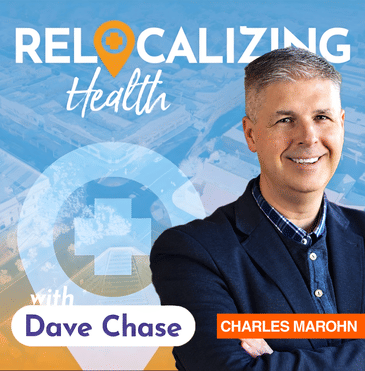
Welcome back to Relocalizing Health. In this episode, host Dave Chase sits down with Charles Marohn, founder of Strong Towns and renowned author, to explore what it truly means for a town to be "strong." Drawing analogies from the built environment and decades of on-the-ground civic work, Chuck shares how robust communities rely not just on fiscal sustainability or infrastructure, but on engaged citizens who are empowered to solve problems collaboratively. Together, they dive into stories of transformation in places like Ashtabula County, Ohio, discuss the cultural and mindset shifts necessary for local change, and outline practical frameworks for making meaningful progress, one small step at a time. Whether you’re a civic leader, public sector employee, or just someone who cares deeply about your community's well-being, this episode will leave you inspired and ready to roll up your sleeves to co-create healthier, more resilient places.
Timestamps:
00:00 Defining sustainable city development
04:41 Struggling Ohio school district finances
08:46 Using relatable examples for change
10:33 Engaging the local community
15:21 Rethinking public investment strategies
17:29 Businesslike approach to running cities
22:48 Implementing community development projects
26:16 Southcentral Foundation's healthcare transformation
29:49 City council meeting dynamics
30:32 Creating an equal meeting environment
36:40 Importance of community dialogue
38:02 Wrapping up healthcare insights
Building Strong Towns: Insights on Community Transformation from Relocalizing Health
In this insightful episode of Relocalizing Health, host Dave Chase sits down with Charles Marohn, founder of Strong Towns and author of several acclaimed books, to discuss what makes a town truly strong. Their conversation dives deep into the essence of community, sustainable development, and the steps individuals and groups can take to drive meaningful change in their towns.
What Defines a Strong Town?
The episode opens with Dave Chase asking a central question: "When you say a town is strong, what does that mean?" According to Charles Marohn, a strong town is much more than just the sum of its infrastructure; it's about whether a community can sustain itself over time, both financially and civically. He emphasizes that strong towns are not simply those with functioning water systems or trash pickup, but those where neighbors are the first call in times of need rather than defaulting to city hall.
A strong town is engaged and participatory, with local government viewed as something created together, not just a service delivered. Prosperity and a "good life" are intertwined in places where people directly contribute to building and evolving their communities.
The Importance of Mindset Shifts
One of the most significant insights from the conversation is the role mindset plays in community change. Chuck reflects on his early days as an engineer, assuming that clear financial analyses would naturally prompt better decisions. However, he soon discovered that simply providing information is not enough. Behavioral change is driven as much by culture, psychology, and incentives as by data itself.
The conversation highlights that transformation often begins in times of financial duress or crisis, when old patterns are no longer sustainable. Yet, the real breakthrough comes not just from necessity but from shifting the underlying decision-making environment and cultural expectations.
The Power of Small Steps: The Humble Four-Step Process
A core takeaway from this episode is the "four-step process" that Chuck outlines for initiating positive change in local communities:
Humble Observation: Spend time observing where people are struggling to use the city as it exists, with genuine humility and openness.
Next Smallest Step: Rather than aiming for a grand solution, ask what immediate, small action can make it even a bit better.
Do It Now: Take direct action, using available resources, without waiting for studies or committees.
Repeat: Continuously observe results, learn from outcomes, and keep iterating.
This cycle not only minimizes risk and increases adaptability, but it also ensures that solutions are grounded in real-world context and actually address people's needs.
Empowering "People Who Care"
The podcast explores the idea that local change agents, not just officials, are central to building strong towns. Engaged citizens like Rotarians, business owners, and passionate young people play pivotal roles as trusted messengers. Chuck describes the importance of building empathy bridges and spreading meaningful dialogue throughout the community, leading to authentic bottom-up change.
He also highlights how cities can foster inclusive conversation by rethinking traditional meeting dynamics. Instead of the typical adversarial setup, arranging for all parties to sit together at a table encourages collaboration and signals joint stewardship of community issues.
Stewardship and the Ongoing Journey
The discussion ends with a powerful reflection on stewardship: the work of community building is never finished. Unlike a linear project, city development requires constant action, learning, and adaptation. The healthiest towns are those where residents view themselves as stewards rather than customers, actively participating in shaping their environment for future generations.
For anyone interested in relocalizing health, sustainable cities, or civic engagement, this episode of Relocalizing Health with guest Charles Marohn provides practical advice and inspiring stories to guide positive transformation in any community.
Ashtabula story:
Short version - https://relocalizinghealth.com/episode/case-study-the-poorest-county-in-ohio-kept-450-million-home-and-changed-everything
Full Conversation with Bryce Heinbaugh - https://relocalizinghealth.com/episode/how-community-owned-health-plans-are-transforming-healthcare-and-boosting-local-economies
Full Conversation with Dr. Brad Schneider, Maria Fowler, and Casey Billington - https://relocalizinghealth.com/episode/how-ashtabula-county-reclaimed-healthcare-direct-care-and-community-plans-beat-corporate-systems
Learn More:
RosettaFest 2026 - https://rosettafest.org/
Health Rosetta - http://healthrosetta.org/
Nautilus - https://www.nautilushealth.org/
Kynexions - https://kynexions.com/
Dave Chase - https://www.linkedin.com/in/chasedave/
Podcast Website - https://relocalizinghealth.com/
[00:00:00] When you say a town is strong, what does that mean? I feel like the healthiest communities are the ones where if there's a problem, the first call is to your neighbor, not to City Hall. In other words, a lot of it is just set up to deliver service, right? Like, oh, you need a knee. Here's the knee person. You don't even know their name. And you, in a sense, commoditize a thing because it's easy to manage that way, as opposed to deal with a human, which is messy, takes time.
[00:00:29] Local government, in particular, is not something that we pay for as a service and then it is delivered to us. It is something that we create together. Welcome to Relocalizing Health. I'm Dave Chase.
[00:00:57] We've long described what we're trying to do to transform health care by using an analogy from the built environment. You know, no analogy is perfect, but like the built environment, health care is massive. It's entrenched. It's local. Yet, if you look at the way buildings are built and designed, it's fundamentally transformed over the last 25 years. And my guest today, I don't believe, is in the business of building individual buildings,
[00:01:25] but in kind of that adjacent space, spent, you know, decades helping towns build the civic and financial capacity to solve their own problems. You know, really one step at a time. Chuck Marone is the founder of Strong Towns and the author of books, Strong Towns and Confessions of a Recovering Engineer. I am a devoted listener to his podcast. Definitely recommend it. You know, and getting health plans to actually work is, you know, half the work we do.
[00:01:52] But, you know, we've done that thousands of times now across our movement. But it's especially critical now as public employers are getting hit the hardest in at least 20 years with avoidable but really common premium increases that is stressing budgets. But I think the harder half is the community engagement, the kind of social movement that's really underpins any kind of big transformation and getting a place to actually organize it around its own transformation.
[00:02:20] So that's what Chuck has spent his career doing. I'm going to use an anchor story that we've had previous episodes around Ashtabula County, Ohio. And I'll touch on that a little bit. But if you do want to go back, you don't have to. But you can hear that story. It's quite amazing. That's one of the poorest counties in the state of Ohio. And their health plan at the school district, as well as the city and county level, were running dangerously low. And there's some analogies here. It did get turned around, and that's where we're headed.
[00:02:50] So Chuck, welcome to Relocalizing Health. Really appreciate you joining us. Hey, Dave. Very nice to be here. Thank you. Now, basic question. When you say a town is strong, what does that mean from your perspective? Good question. It's a fair question. I feel like it's something that has evolved over the time that I've been doing this work at Strong Towns. Originally, it was can the city sustain itself indefinitely? And I think that's probably still core to the definition.
[00:03:18] You know, can a place take care of its own water system, its own sewer system? Can it maintain its own roads? Can it pick up the trash? So many of these core functions of government, we assume that the city can just do. And the reality is, is the fiscal situation of most of our cities today is that they're really strung out. And that's a huge burden that most of them can't meet, actually, not long term.
[00:03:42] I think the definition has grown, though, because we've started to, as our movement has matured, and as we've kind of wrestled, I think, with even deeper questions, we've gotten to this point where we've started to talk about living a good life in a prosperous place. And those two things go together. And let me start with the prosperous place one. You know, we don't believe that every city is going to be incredibly prosperous tomorrow.
[00:04:05] It is a process, and it is an ongoing, continuous, in a sense, never-ending process of improvement, reinvention, reiteration, maturing. We want cities to be able to do that, to adapt and evolve and change. The good life part is really a statement on how that is done. And we think that cities are stronger when people can participate in the building, the changing, the evolution, and the creation of those places.
[00:04:30] Government is not, local government in particular, is not something that we pay for as a service, and then it is delivered to us. It is something that we create together. It's something that we work together at building. Yeah, no, that's great.
[00:04:42] And, you know, having come out of technology, I sometimes, you know, go back to tech metaphors, and I think of the built environment kind of being like the hardware and the things you mentioned, you know, the culture and that cohesion or not in the community, things like healthcare, in a way, the software. And, you know, both really matter. And we've certainly seen that in our world.
[00:05:07] And as I mentioned, this school district in Ashtabula County, Ohio, 8th poorest in state, they were down to a couple hundred thousand in their reserves for their 300 staff. And, you know, sometimes those financial constraints really force a change. And I'm sure you've come across that. And as I mentioned earlier, it's getting really bad in terms of healthcare. So sometimes necessity is a mother of invention.
[00:05:35] But I'm curious, like, do you find that to be the case sometimes? Communities don't really address some of these elements you mentioned until they're in more financial duress? Or what tends to be the trigger that, you know, leads to the change that you're trying to help people with? It's funny because in the very early days, actually before Strong Towns, I was doing financial analyses for cities that I was working with. I'm an engineer and a planner.
[00:06:00] I was not prompted to do this, but I looked around the room and I recognized that we were making multimillion dollar decisions on infrastructure projects and nobody was analyzing the economics of it. There was an underlying assumption that growth was good. And so I started to do this. I said, OK, we're spending, you know, two million dollars. How long is it going to take us to recoup that two million dollar investment?
[00:06:23] And the answer in every instance was we never recoup it like we the maintenance of it comes due before we actually recoup the money. Like we are we are just committing to a long term negative return on investment kind of project. I actually thought that just having that math would prompt people to make different decisions. I was a young, naive, engineering esque kind of person.
[00:06:46] And I think one of the earlier things that I struggled with in Strong Towns is if people are given great information, why do they still do dumb things or the wrong thing? I started to read psychology and group decision making and all this. And I recognized in myself my own behavior. You know, I would like to lose 10 pounds. I get up every morning and I'm like, I'm going to lose. I'm going to commit. I'm going to do the things I need to do to lose 10 pounds.
[00:07:11] And then I walk by Dunkin Donuts on my way to work and I'm like, oh, my stomach's a little hungry. And that glazed donut sounds good. And it's just easy. It's there. And so you you realize that decision making is not just a function of having really good information, but it's a decision making of culture. It's a decision making process of environment. You know, it's the questions that we're being asked and the context we're being asked them in.
[00:07:37] These things all lead us to the destination that we're at. And if we want to change that, we not only have to just commit to doing something different, but we actually have to change the decision making environment. The incentives that we have, the cultural expectations we have around cities and growth and what that provides. It's a big, big lift because it's not just getting good information to the right people. Yeah. You know, and I'm sure you find a similar thing where that mindset shift is the maybe the biggest obstacle at all.
[00:08:07] I mean, there's plenty of challenges ahead once you have that. Do you find there are, you know, obviously your podcast is probably part of it, your books, right? People read those and I'm sure are impacted. But do you find there are particular things that are helpful in driving that mindset shift across the key stakeholders that matter and the work you're doing? The short answer is yes. And I feel like it's this. When I go to a place, I can't show them an example from their place.
[00:08:33] I've been traveling around giving talks. I do probably 50, 60 lectures a year on the road in different places. I've written three books. I got a fourth one coming out and I always do a book tour. And those generally are going to cities and having this conversation. I found really early on that if I share examples from the city, nobody listens to them. If I go in and I say, OK, like I coming here tried to understand you and your unique situation and here's what's going on.
[00:09:00] There's a million stories and reasons and excuses why they're different and it doesn't matter. But if I take an example from a neighboring city or a city that feels like them or an example that they can relate to that's not theirs, they can analyze it almost in like a third party, you know, interested scientific kind of way. And then if you start a dialogue, they can actually ultimately apply it to them. I found that the messengers for doing this is not me, something I wrote, my podcast.
[00:09:30] What we're doing is informing the messengers who actually evangelize and bring this to their place. Hey, we're doing something over here. Strong Towns wrote an article about a different city that did this similar thing. I realize it's not the same, but it seems to rhyme. Are we going down a similar path? Hearing the message from a trusted messenger, someone who is vested in you, your place, cares about it, has similar cultural backgrounds, understandings, you know, neighborhood relationships.
[00:09:59] Those are the most powerful people to share a hard message, a message about doing something different. Because they don't do it from a position of scolding or I'm better than you or I've got this figured out and you don't. They do it from a position of love and care and empathy. And I understand and we want this to be better together. In your context, are those usually somebody in the public sector? Or is it a mix of people maybe on some economic development group or whatever?
[00:10:28] Like who are the players usually at the table for those kinds of pivotal moments? It's funny because my early assumption, you know, as a young engineer, my early assumption was, if I can just get to the mayor, if I can just get to the city council members, they'll fix everything. And they're probably like they're very interested in it, but they are less sensitive to the solution than what can I explain to voters and the people I represent. So what we've found is that there's messengers everywhere.
[00:10:57] Elected officials certainly can bring people with. Technical professionals can provide materials, provide insight, provide understanding, and they can be helpful in a lot of context. But really where we found the most momentum is in the broad general public. We have a term we call people who care and people who, you know, everybody cares about something, but we're looking for people who care about their place and are willing to have conversations with others outside of their own, in a sense, comfortable friend group.
[00:11:27] So it might be a Rotarian who is comfortable standing up in Rotary, but has never gone to a city council meeting or, you know, doesn't want to say something that might be controversial because they run a local business. Can they speak to the Chamber of Commerce or the, you know, the local business group? It might be a young person who is frustrated because they can't get into a house and housing is too expensive. And, you know, they don't own a car, so they're walking and the walk is dangerous. Can they speak up?
[00:11:56] Can they find others to help them speak up? Are there small things they can do that would raise attention without being divisive or creating, you know, the kind of negative blowback you often get in these situations? We've got 280 roughly local groups. We call them local conversations. And we call them local conversations instead of chapters because they are about spreading dialogue amongst the community
[00:12:20] and kind of authentically working with people to apply Strongtown's bottom-up ideas to how they make places better. And those groups are amazing because they really focus on how do we build, we talk about an empathy bridge, a bridge of empathy. How do we understand the situation, the motivations, the sensitivities of the people we're talking to so that we can find common ground to solve some of these problems together? Yeah, no, I love that. People who care, then maybe that will be the title of this podcast. I really like that.
[00:12:49] And, you know, one thing is I, you know, came across some of your writing. Hopefully I'll get it right. But I remember reading about a kind of a four-step process of humbly observe, you know, ask what's the next smallest thing, do it now, repeat. And assuming I got that right. You did. Walk me through that process and the way you'd explain it to someone like those in those local conversations that you want to initiate and the people who care. And, but they're just getting started.
[00:13:17] It's funny because that was not an early Strong Towns thing. That, that came about. I mean, I started writing the blog in 2008 after a decade and a half of professional work. That probably didn't occur until 2015 or 2016, the four-step process. And it's so central to what we do. I was getting all kinds of people who would say, Chuck, we think you're doing a great diagnosis. We think Strong Towns has really figured something out. For example, this street is really dangerous. We need to fix it.
[00:13:45] We're going to apply for a federal grant and completely redo it. And it's going to cost $5 million. And it's going to take four years to work through all the paperwork and the process. In the meantime, people are dying. People are getting hit. It's still unsafe. I was pushing back on it. It's like, that's not the right response. Well, what is? And I'm like, okay, how do I explain this in a way that's actionable? And I put it on a slide and I just pulled it out at a random presentation. It's probably 400 people in the room. I'm telling you, 20% of the people pulled out their camera and started taking pictures.
[00:14:13] And I'm like, okay, we're, we're onto something here. That's the kind of audience feedback that you want. So the idea is to go out. Step one, humbly observe where people struggle. I emphasize the humility part because oftentimes when we go out and we try to assess a situation, we recognize that we bring our own knowledge and understanding and baggage. But we also often bring our framing, right? Like I'm an engineer. Every problem is a infrastructure problem. I'm a planner. Every problem is a zoning problem.
[00:14:41] These are human problems. So go out, try to be humble and observe where people are having a difficult time using the city as it has been built. Step number two then is a discipline. Ask yourself, what is the next smallest thing that we can do to address the struggle? Not solve it, not fix it for all time, but just alleviate it. Make it a little bit better. What's the thing that we can do with the materials we have on hand with, I would say, straw bales, paint, duct tape, a shovel, cones. Like what are the things we have on hand?
[00:15:11] What can we do that would make this a little bit better? Step three then is to go out and do that. Don't form a committee. Don't send it to a consultant for six months of a study. Don't, you know, apply for just, it's a little simple thing you're going to do. Go out and do it. And then step four is to repeat that process. And by repeating, you're going back and humbly observing. Did this thing work? Did it alleviate things? What did we learn from it? Do people react to it? If we have this as our primary public investment strategy, what we will find very quickly is
[00:15:41] that our orientation shifts from what is the federal program I can qualify for money for? What's the state program that can bring us in some cash? Who's the developer that we can come in and leverage a relationship with to get things done? That's our general disposition at City Hall today. Instead, it becomes where are people struggling? How do we make that better? How do we learn from that experience? How do we co-create this place to actually improve people's lives so that their actions
[00:16:08] inform our actions and our actions inform their actions? And we're doing this beautiful ballet together where we're constructing a place in real time around real struggles that people have. Here's the exciting part. This is not, you don't have to be Manhattan to do this. You don't have to be a super wealthy place to do this. In fact, the places that we've found have done this the best, the most readily are Memphis, Buffalo, Shreveport, places that are really, really poor and struggling.
[00:16:37] They kind of don't have the inhibitions about going out and saying, all right, let's roll up our sleeves. What do we do with what we got? Because that's kind of the way they operate anyway. I feel like the challenge is getting to that next tier of cities that feels like they're too affluent and successful to actually go out with paint and cones and do something. But when they do, it becomes pretty amazing really quickly. I have a weird algorithm on my YouTube where I've got this mix of kind of localism and mayors
[00:17:07] with track and field because that's a whole other story, part of my background and healthcare. And I do see some of these more savvy mayors, you know, out there fixing something at the park or, you know, there's a bump on the bike path and, you know, they make sure they let people know, right, that they're doing it. But it does give you that sense that somebody does care. And I was going to say, I feel like there is a...
[00:17:32] So let me say this in a way that is going to push some boundaries because I do feel like there is a certain, in my youth, you would have called it tree hugging, like overly sensitive, like, hey, we should just all hold hands and clean up trash in the park and our city will be better. I don't have any problem with people who think like that, but I always try to make it clear to mayors that what I'm talking about, what Strong Downs is talking about, is a really good investment strategy.
[00:17:57] If you look at what a CEO who takes over a new company does, if the company is struggling and failing and having negative cash flow and their balance sheet is impaired, they don't launch a brand new initiative that looks like the five failed initiatives they just had. That's what cities do all the time. What they do instead is say, okay, how do we go back and tighten this up? How do we get more out of this? How do we make this work better? How do we fix this? They actually get in the trenches and roll up their sleeves. What we're talking about is almost like a business-like approach to running government
[00:18:27] competently and well. And the cool thing is, is when you do that, any city can do it. It doesn't take a lot of capital. You start small and guess what? Your voters, your residents, your citizens, the people who care in your place absolutely love it because that's what they're begging for. Yeah. Yeah. No, that's great. And there's a parallel in the world that we operate in where there's a set of people who are true believers and they're very angry at the status quo and they want to rip off the
[00:18:55] band-aid and do our complete blueprint. And there are some rare instances where that makes sense. But, and we have high expectations of where we want to go. We have this thing called a plan grader. And I'm like, you know, taking a health plan that scores a 10 to a 25, frankly, is a lot bigger deal than from 50 to 65. And, and it's unsexy stuff of, you know, some of it's listening, but like literally get educated, like what's going on here.
[00:19:25] And before you change anything, the end of the day, kind of like we were the analogy with, with, you know, the corporations is do what you do in every other area of the organization in terms of how you do procurement. They tend to have a whole separate thing for healthcare. And it's like, look at those contracts. Like seems like the most boring thing known to man. But just about every dysfunction I've ever seen in healthcare is codified there.
[00:19:51] And it does, you don't have to roll out some different program that open enrollment. Like you can be working on that stuff every day of the year. And, and it does have a way of overcoming some of the skeptics of like, does this really need to be fixed and all that? So yeah, really believe in that, you know, take those, those steps at a time and build that momentum. And so, you know, okay. So you, you've, you've done that, right? You've taken some of those first important steps. There's some results could be modest.
[00:20:21] That's fine. What are some of the next things in the process that you find? Is it just a lot of that rinse and repeat or there, there's more people who pay attention? How does it sort of unfold after that? Usually. I feel like there's a recognition that needs to come before I answer that question. Because if you look at a human life, there's a beginning, a middle and an end, right? There's phases. And we recognize that like prenatal care is very important. We recognize that infant mortality is a thing that we, we can solve and make better.
[00:20:51] We recognize that youth education and preparing them to be an adult. And then there's this period of time and my kids have just started it there in their early twenties in college to I'm 53. So I'm getting close to that part where you start the, okay, body maintenance. And like, I, I, I got to go to bed at night instead of staying up late. Like I've got to, you know, do these things. My body's starting to push back on things and I can see where, you know, you get to an end of life. Here's the thing. Cities don't have that. They actually don't have that trajectory.
[00:21:21] They have a, in a sense, continual maturing. So instead of looking at it as a beginning, middle and end, what you have to do is look at it more like a plateau of step stages. How do we, in a sense, go to the next plateau of maturity? How do we achieve the next, you know, unlock the next step? And, you know, I don't want to freak people out, but like, there's a hierarchy between my like small little town and Manhattan.
[00:21:46] And if you look at them both over time, Manhattan was a grid with little buildings on it. And it grew, matured in a sense over time. That doesn't mean every city needs to come become Manhattan, but it does mean that it never ends. There isn't like a process where you, you know, wipe off your hands and dust the, you know, get the dust off your boots and say, well, we did it. Like, let's sit down and rest. Like you don't get that opportunity. And so, yeah, it is iterative over time in a neighborhood that is struggling.
[00:22:15] There's almost an infinite number of small little things to do. When you get those going, what happens is that a lot of your assumptions about the place become corrected. You gain a lot of information. You start to learn a lot more about how people actually live and what their lives are. And it illuminates that next level of project intensity. It's like, okay, I didn't realize that so many people crossed the street here. I didn't know that was such a big deal. My models didn't show me that. My data didn't show me that.
[00:22:44] But now I'm out here humbly observing. We did this little thing. People are reacting to it. So now we can do the next layer of investment with more confidence. We can replace the cones and the paint and the straw bales with permanent curb bump-outs. And now that we've seen that done and that work, we can take that insight that we've got and translate that to the next project that we're scheduled to do, maintenance project over here, and see if that works.
[00:23:08] Okay, now we see that adding cottages in the backyards actually increases housing at a low price point. We can do that over in this neighborhood too. And so it is government that is not a problem to solve, but an ongoing maturing process to manage. And I actually think in that way it is more like being a parent. We use the word steward, right? Like you are a steward of something.
[00:23:35] Because I think we can all, you know, we're all working on projects at work and projects here and there. And like they have a finish. They have an end. But being a steward or being a parent is something that, you know, if things work out, you know, tragedy doesn't occur in any way. You never end that. I mean, my mom is in her 70s. She's still my mom and she still feels like she needs to help me and guide me. And I appreciate that. Like I value that.
[00:24:00] I think that when we look at cities as something to be stewarded, we recognize that there is no solution. There is only action, action, action over time. Yeah, yeah. No, I love that. And the stewardship word is one that we really believe in, in our blueprint. We call it individual stewardship. And the choice of words is very intentional. It's not patient navigation. Yeah. The thing I like about- Dollar extraction. Yeah. Yeah. All that.
[00:24:29] But it's, you know, individual is an individual, right? Like there's a, there's, it's a synonym for a person in one way, but there's also meaning of like, you know, what you may want out of life is different than what I may want out of life. Even if we had, or our health, even if we had the exact same condition. And then that stewardship is this, you know, really infinite sort of multi-generational relay race, you know, that do your best while you're here, you know, and, and pass it on. So that's great.
[00:24:59] I feel like with medicine too, there, there is, there's this dichotomy in our system and I'm not a, I'm not a practitioner. Obviously I don't know. I'm just, I've gone to the doctor. Like I've experienced it as a consumer, I guess is what you would call me in the system. But. You know, I've, I've watched. And when my doctor and I are working on a problem together, that problem becomes real because I, I, I'm the only one who can actually solve it.
[00:25:23] You know, when I go in and he's like, well, you need to, you need to increase your aerobic activity three days a week to do this and that. And I'm like, yeah, okay. That's great. Whatever. It, it, it, it doesn't work. It's just advice, not working on it together. When we're working on it together, I actually go in like, okay, I hope my blood pressure is where I want it to be this time. And like, he's like, yeah, you know, okay, we're getting it. Like we're doing this. I feel like a lot of it is just set up to deliver service, right? Like, oh, you need a knee. Here's the knee person. You don't even know their name.
[00:25:52] You just go in and get it done. Here's your thing. Well, we got a pill for that. Here's the pill. Go in and get it. And then, and you, in a sense, commoditize a thing because it's easy to manage that way as opposed to deal with a human, which is messy, takes time. It doesn't always work right. This thing doesn't work for this person, but it does work for this person. And that, that, that's much harder to deliver at scale. Yeah. Yeah.
[00:26:17] No, it reminds me of, I had the CEO of the South Central Foundation, which is, they steward the health of about 70,000 Alaska Native people. And they, I have not found a greater turnaround in American history, not healthcare history, like just an incredible story that most people don't know about. And they say, you know, most in healthcare is about transaction.
[00:26:42] Our primary output is relationship because they're dealing with, you know, as challenging as circumstances as you can have. And, and the, the chief medical officer described it in an interesting way. Said, you know, if it's a surgery, it's some trauma, you know, the patient's out, right? That's more like, you know, trying to train and, you know, a pitcher to hit a target. And it's very kind of shop production line type of model. But for the vast majority of healthcare, when it's chronic disease, it's more like trying to throw a bird at a target.
[00:27:12] You know, like you have some influence to kind of like get in the direction, but all these other dynamics, all that messy human stuff makes all the difference in the world. So yeah, that's powerful. Well, especially when you recognize that humans don't do what the models say they will do. I mean, this is where I think from traffic engineering, we see, you know, we've got a road, we're going to add two lanes, it will do this. And then it never works that way because people drive different ways. They change their habits. They, you know, oh, you created more capacity.
[00:27:42] Well, I'll just move out further now. You know, there are all these iterative feedback loops that our models can't predict because they're human. You know, we had a bridge fall down in Minnesota 20 years ago, a major, major 220,000 cars a day. The deaths from that was horrible. The impact on the psyche here in Minnesota was horrible. The prediction was in 48 hours when the Monday morning commute happens, like this is going to be a disaster.
[00:28:09] And the reality is, is people got to their destinations more quickly because everybody knew it was bad. And so they adapted and left at different times and did things differently. The healthcare is the same way. I feel like we do try to have, there's a book called Seeing Like a State that I think is really helpful in explaining this. I don't know if you've read this book or not, but one of the examples he starts with is forestry. And they were trying to get more forest production. And so they were measuring certain outputs. And so what they did is they started planting forests to maximize those outputs.
[00:28:38] And it worked really great for a short period of time. And then they recognized after a while that the forests weren't thriving because you can't just plant a forest. A forest has to emerge from all these complex interactions. Or the wood you get is really weak. It is subject to like a parasite coming in and wiping out the whole forest because it's monoculture. Like there were all these things that like didn't work. But the state wanted it because they wanted the production number.
[00:29:03] I feel like when it comes to healthcare, when it comes to traffic, when it comes to, you know, all kinds of these different things, we see efficiencies by centralizing and commoditizing the delivery. And yes, like that can benefit. But when it overwhelms the individual, the adaptation, the ability to make different decisions and respond differently, you lose all of that internal strength is what we would call it. You know, that is the essence of being a strong place. Yeah, yeah, definitely.
[00:29:32] And you have this term that makes me think about residents as shareholders, not customers. When you see that flip, what tends to change in terms of the meeting dynamics, the way decisions are, you know, made and kind of, you know, beyond the theory to the mechanics? I'll give you a very concrete picture that I think everybody will be able to get their minds wrapped around. When you go to a city council meeting, the city council is sitting up on the dais. They're up there, up high. You maybe stand at a podium.
[00:30:02] Everyone's staring at you. You're on camera. You're all that. It is like addressing Caesar, right? And it creates this power dynamic where this is the decision maker and I am small. I have seen cities flip that around in a really helpful way. And they can't do it all the time because cities do have to make decisions. There are decisions they have to make. But I've watched cities. We were up in Medicine Hat in Alberta, Canada, where they had done this really, really well, where they said, okay, this is not a meeting where we have to make decisions.
[00:30:30] This is a meeting where we have to discuss. And so what we are going to do is we are going to all sit at a table at equal height. And when people address us, they'll be invited to sit at the table with us and be part of a dialogue. And then we'll go to the next person, the next person, the next person. So that there's not the inherent power dynamic. We're actually trying to work on this together. That may seem superficial because, you know, you still have the mayor and the mayor has power and you still have the council and they can vote on things. And the person addressing them can't.
[00:30:58] But it really, really does change the dynamic of the conversation in a way that is powerful. And I think correctly communicates to the, you know, shareholders, the people who care, the strong citizens in the community who are part of co-creating and building that place, that this is a joint project that we're working on. You've empowered me to make certain decisions. Like I get to approve the budget. You don't. But the budget is our budget. It's not my budget. Yeah. Yeah.
[00:31:26] I know that is, it's symbolic, but yeah, I think that is powerful. And, you know, just does create a whole different message. So really appreciate that. I feel like there's an indicator of a healthy city that is subtle. I'm going to share this and I think you'll appreciate it. I feel like the healthiest communities are the ones where if there's a problem, the first call is to your neighbor or to someone in the community, not to City Hall.
[00:31:55] In other words, there's an intermediary layer of problem solvers and just, you know, people who are taking action and doing things that in a sense is not just, hey, I'm having a conflict with my neighbor. I'm going to call City Hall. Hey, I don't like this thing. I'm going to complain to City Hall. Because then City Hall just becomes like a switchboard for, you know, triaging complaints.
[00:32:16] If you have a city that has an action orientation, a horizontal service stewardship kind of orientation, what you see is that people just step forward and do stuff. And it's embraced. It's understood. Sure, they might overstep a little bit and there's some pushback and dialogue and discussion. But the first call isn't to your internet's not working. You call your service provider and you're like, fix my internet. If something's wrong with the city, you call City Hall and say, hey, I pay for this service. Fix this service.
[00:32:46] Instead it is, all right, the city is something we do together. I'm going to get three people from up the block that I'm friends with and we're going to go figure out how to fix this thing. And maybe we might need help from the city, but we're empowered to actually do it. And those places are super exciting to be in. It's also remind me of James Fallows. You probably read the book that I think was Our Towns, you know, where he traveled around with his wife who co-wrote the book. Debbie, Deborah, maybe? I forget.
[00:33:15] And, you know, he would go into towns like they might have a brew pub or something. And, you know, you'd find those people who were, you know, the people who care, you know, who had those connections. So I do think that it's a small thing, but it's huge, right, at the end of the day. And, you know, beyond what you've shared, you know, if you were, you know, talking to somebody who, you know, they might have some official role, like they're a school board member or just a regular employer or neighbor.
[00:33:43] You know, what would be your piece of advice of like how to get that something going this week? What do you think would be a good place to start? It's really interesting because I feel like there's tactical advice and then there's like macro advice. The tactical advice is, let me give the macro advice first, because I feel like the macro advice is, you know, proceed with humility, think small, ask what the next step is really the four step process, right? Like, I don't know what that looks like in your place.
[00:34:09] But when your city staff brings you the $20 million complete redo project that solves the problem, you know right now that A, that's not the next smallest step. B, the math behind it is probably really suspect. And C, the idea that you solve any problems at a city is just wrong. Anyone who brings you that framing doesn't understand how cities work. So back off from that and really kind of push the what's the next smallest thing. But the tactical advice is to me the one that's kind of exciting.
[00:34:37] Our executive director, John Reuter, was city council member in Sandpoint, not too far from where you have been, you know, northern Idaho. And he, when he was on the council, he actually wrote down, I think it was 30 note cards, things that he cared about, things that he wanted to see changed. And instead of going in there on day one and saying, here's my agenda, here's the things I want done. What he did is he just sat in his role and let issues come to him.
[00:35:02] And when an issue came to him, he said, well, note card number seven is something I'm interested in working on. This seems like a problem that is caused by this. Let me try to align these things and bring other people in and get this. By the time he finishes for your term, he decided not to run again because he had crossed off all 30 note cards. And so if you are at City Hall, what you see is that there's an endless number of problems and issues. And if you can walk in there with not the solution, but a way to approach that, that makes productive progress.
[00:35:30] You can be really effective really quick by just being the person with those answers. Yeah. Yeah. Yeah. That's great. As we wrap up here, you will come in, you know, in your book tours. Often you probably go to some of the same places or maybe you're drawn in some project. When you have been in a place, you come back there.
[00:35:49] What tells you that, you know, one community is sort of crossed over into that, you know, that kind of shareholder mindset and following some of the advice you were just sharing versus the ones that don't? I feel like there's two things that jump out at me right away. The first is the questions they're asking. I really do think that in City Halls across the country, there is a mindset of papering over known problems because they feel unsolvable. And that's not a criticism of a person. It's a criticism of like a mindset.
[00:36:19] We don't have a collaborative, let's get this out of the open and talk about it. You know, it seems overwhelming. So let's find the way to paper it over. I feel like the places that are having the dialogue, not in terms of who do we point the finger at from the past, you screw this up. But like, OK, here's the hand we're dealt. Let's deal with it honestly and try to handle it. These are places where the dialogue tends to be really productive and helpful.
[00:36:44] I think combined with that, the other thing I would point to is if city council meetings are just brawls where like a litany of people are showing up yelling at the council, the council's like in defensive, like hiding under the turtle shell kind of thing. And then decisions happen outside of that forum because this is not a productive place. Those places tend to be really messed up in my sense. If those disagreements are happening out in the community, a strong town is not a harmonious place where everybody agrees on everything.
[00:37:13] It's where productive dialogue takes place. So if you can go to the soccer field and the parents are actually like talking about things and they're somewhat informed and they've got different opinions, but they're actually discussing them. If you can go to the barbershop and the talk in there is, yeah, there's a project going on. And yeah, I saw, you know, that. These are places where by the time you get to the council meeting, by the time you get to like the official thing, there isn't like the flame throwing and the bombing.
[00:37:40] There's people who have rolled up their sleeves and are saying, all right, how do we solve this problem? There's a healthy dialogue in the community going on. And I'm here representing this group or I'm here as part of this discussion. And we were part of this workshop or there's this thing going on. And now you're getting really healthy decision making. When I see those two things, I'm like, this is a place I want to invest time in. Wonderful place to wrap up. I had high expectations having listened to your podcast, but you definitely exceeded them.
[00:38:08] And, you know, as I mentioned at the outset, we've long used the analogy of, you know, the built environment and communities, you know, applying into healthcare context. And I hope those who want to tackle the healthcare problem can see how these approaches transcend different categories. And, you know, it's very apparent, you know, Chuck spent his career seeing them. I'm sure not every instance has been great from day one. And that's the beauty of these things. You see it enough times.
[00:38:38] You see the patterns of repeated success or, you know, the things that lead to not achieving the big objectives. And that through that next smallest thing done, repeated through communities that have learned to see themselves as shareholders instead of customers or citizens instead of subjects. I think it's really powerful. You know, we've seen that in our community. Take those small steps. Can be a small employer. Like Ashtabulo is a great example.
[00:39:04] You know, we talk about the public sector entities, but it actually started with an employer with just 38 employees. So those small steps are really powerful. And they can really get, there's the metaphor or the fable of the mustard seed in the Bible that, you know, it's the smallest seed, but it can just create something huge. And so, you know, as we wrap up, you know, find those tools. Got great resources, but it's really the community.
[00:39:32] I just saw something on LinkedIn this morning about another set of people who are collaborating as a result of bumping into each other at our gathering. And these are people who want to roll up their sleeves. And so really appreciate Chuck for joining us. Thank you for listening to Relocalizing Health. And we'll see you on the next episode. Thank you. All right. All right.